Loyalty card design ideas: stamps, tiers and points, by type of business
A gallery of digital loyalty card designs for coffee shops, bakeries, nail salons, barbershops and tea rooms. The three ways to count, the shapes, the collections, and the rules for a card people keep.
A good loyalty card design isn’t judged on originality. It’s judged on what a customer understands in one second: whose card it is, how far along they are, and what they’re about to get. Every card in this gallery answers those three questions. They were all drawn by the same engine that produces our customers' cards in Apple Wallet and Google Wallet, so these aren’t mockups: they’re exactly what a customer would see.
First, decide how you count
Loyalty card design starts with the mechanic. There are three, one per card, and you can switch at any time without anyone signing up again (details on the stamps, tiers and points page).
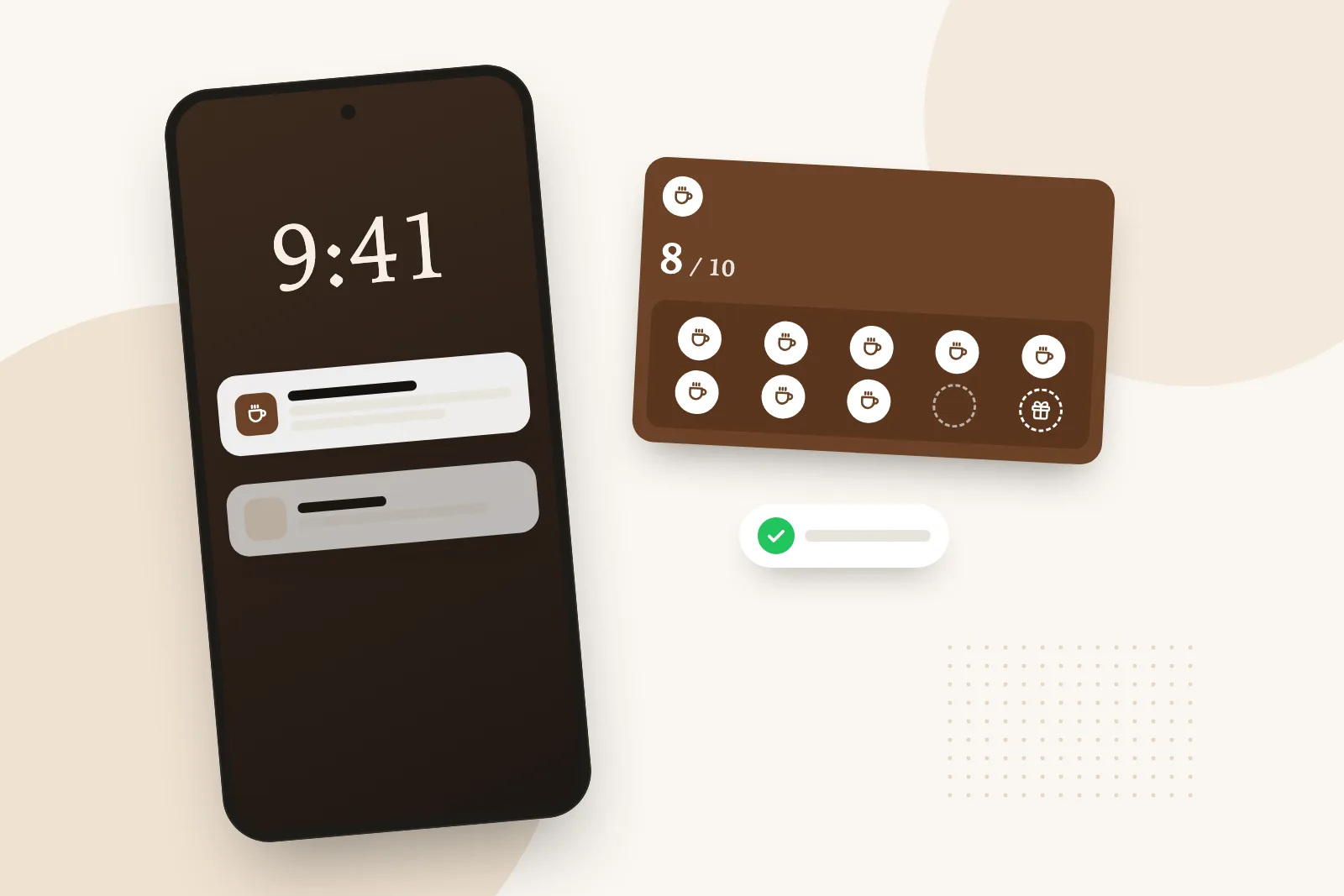
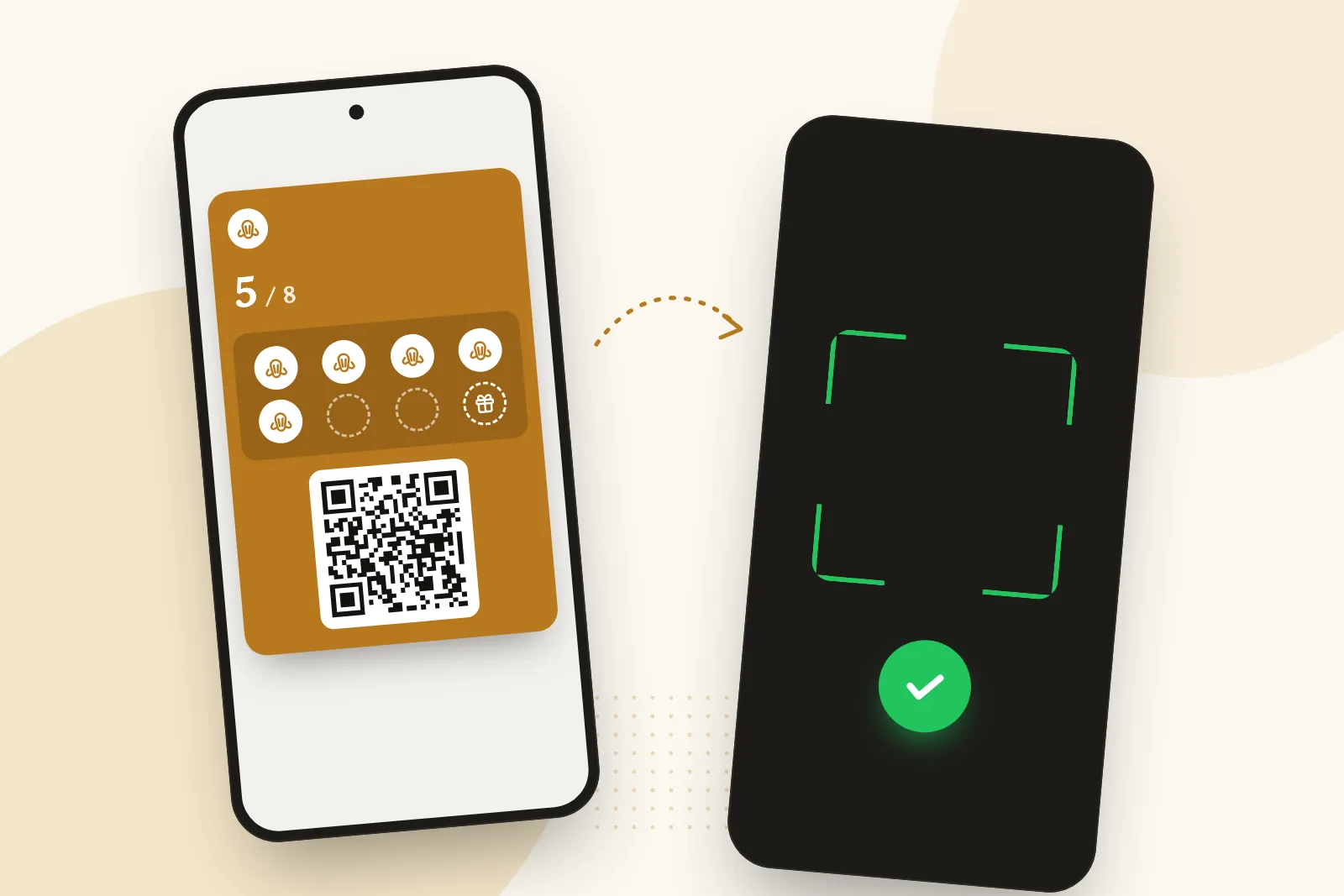
Stamps. Eight or ten visits, one reward, and the card starts over. The paper punch card, minus the paper. Best when prices are steady: a coffee, a haircut, a loaf of bread.
Tiers. Several rewards on the same card: a croissant at visit five, a box of cookies at visit ten. Whoever just earned one can already see the next.
Points. Each visit is worth whatever you choose when you scan, with six presets one tap away. Built for baskets that vary a lot. And you can name them however you like: points, beans, stars.
Shapes: how progress is drawn
Once the mode is set, the card can be drawn in several ways.
For stamps, four layouts: boxes (the classic grid), no boxes (bigger stamps on their own), objects (your product, staggered, faded until earned) and circles.
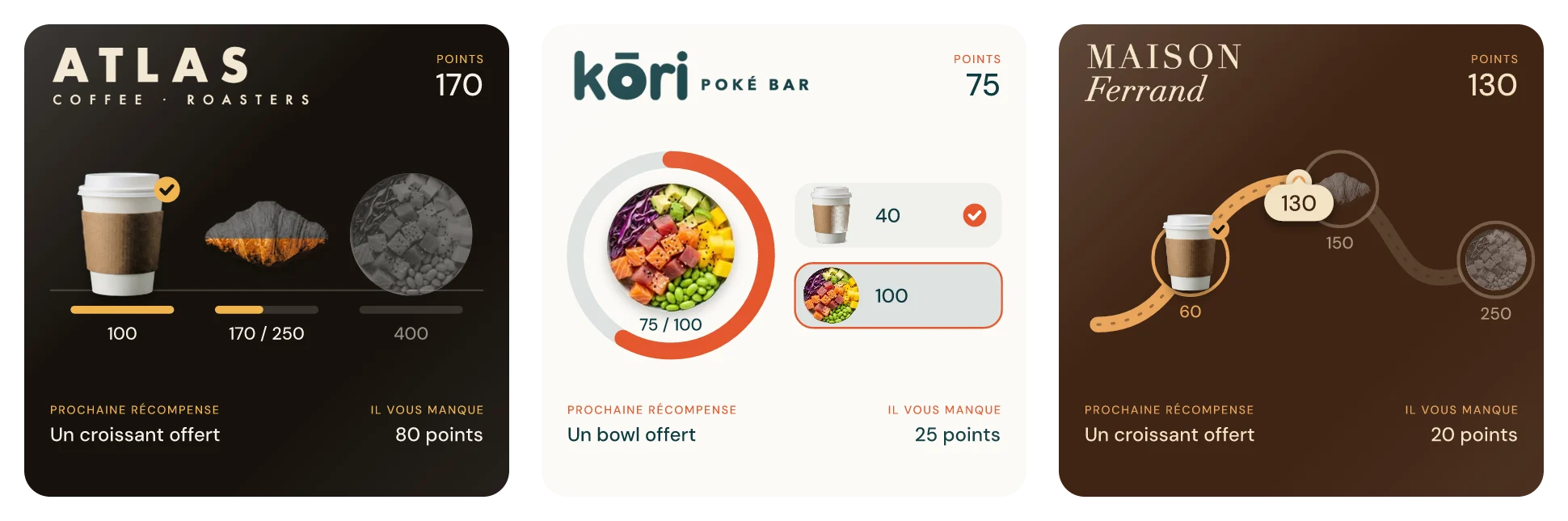
For tiers and points, five shapes: the path, a track that winds toward the reward; the ring, a circular gauge; the shelf, rewards lined up like a display; medals, a line dotted with badges; and the fill, an object that fills up visit after visit. Each reward can have its own photo, with the background removed for you: in color once earned, in gray before.
Collections: a style, three palettes, or your own color
The overall style comes from a collection: Classic café, Botanical, Trattoria, Atelier, or Pass, a cleaner look that leaves room for photos of your rewards. Each collection brings a typeface for your name and three matching palettes. You can also enter your own brand color, down to the hex code.
What you can’t do is make an unreadable card: the ink, labels and empty boxes follow the background color, light on dark and dark on light. Everything is set on one screen with the preview alongside (see loyalty card design).
The gallery, business by business
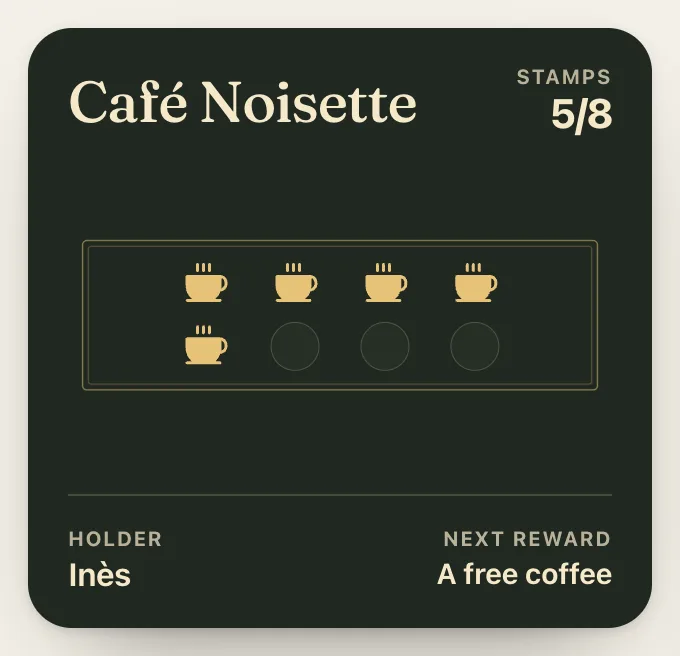
Coffee shop: eight cups, a free coffee
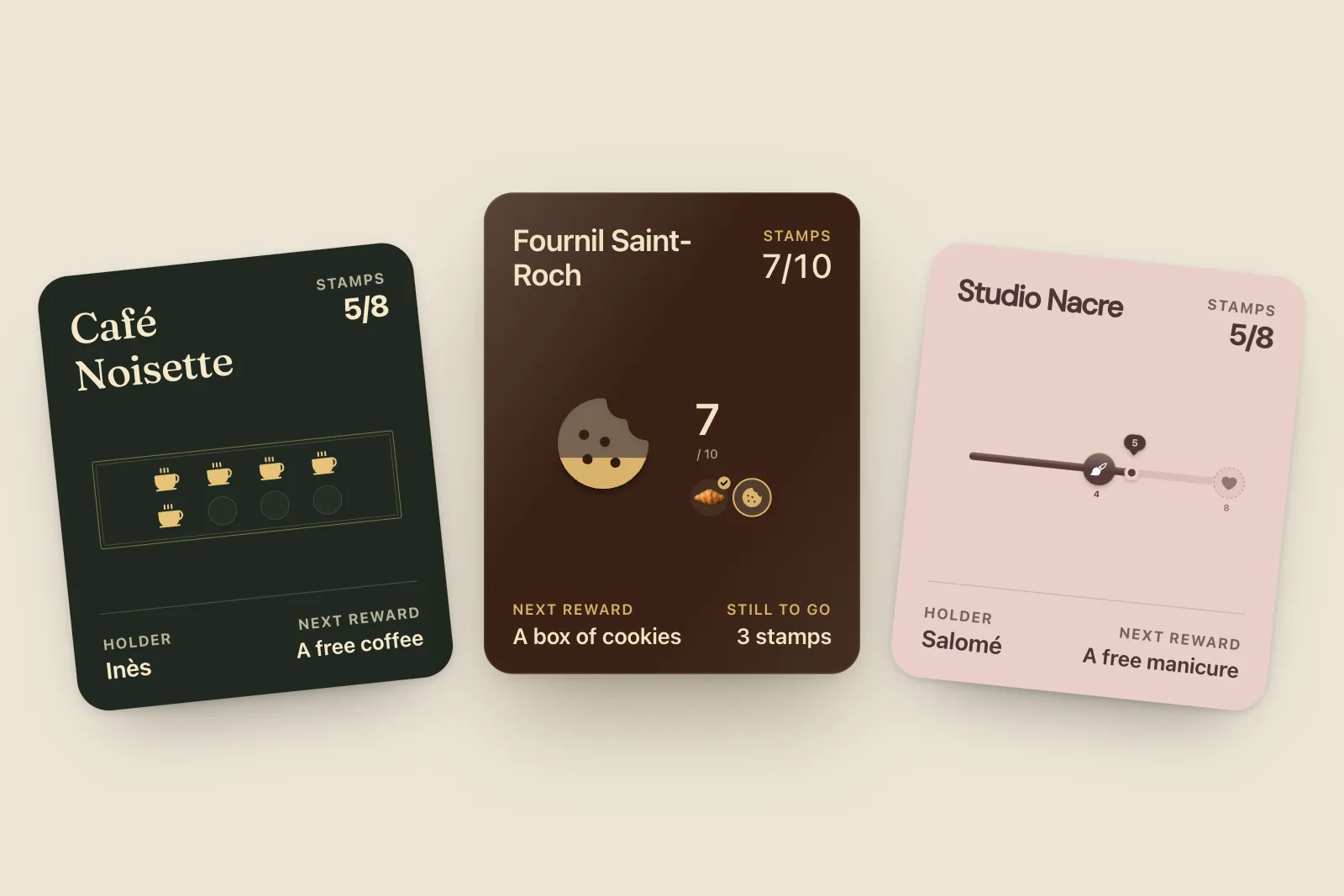
The Classic café collection, dark green palette with gold ink, in stamps mode with a cup as the stamp. It’s the card you understand without reading: five full cups, three empty. Eight visits rather than ten, because people drink coffee often and a closer goal keeps them going. More on choosing the reward in our coffee shop loyalty program guide.
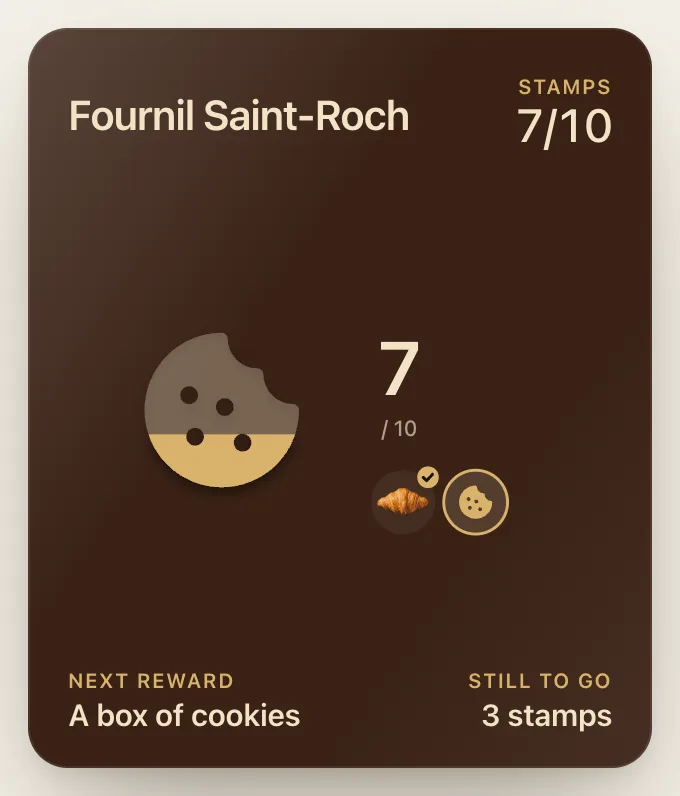
Bakery: two rewards and a cookie that fills up
The Pass collection on chocolate brown, in tiers mode with the "fill" shape. A croissant at visit five (already earned, its photo now in color), a box of cookies at visit ten. The cookie fills up as visits add up: at seven out of ten, the customer can see they’re nearly there. Our bakery loyalty program article does the math on what these rewards really cost.
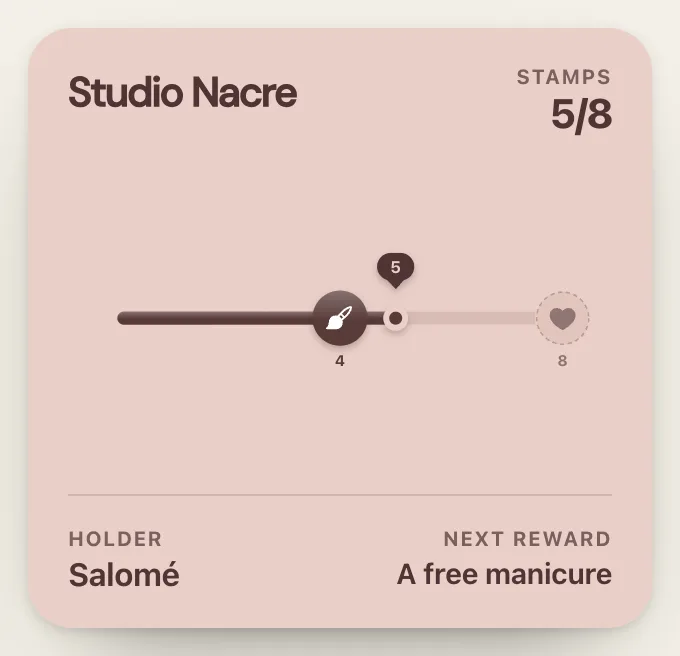
Nail salon: medals on blush pink
The Atelier collection, blush background and brown ink, in tiers mode with the "medals" shape. A polish change at the fourth appointment, a manicure at the eighth. In a nail salon, visits are two to four weeks apart: eight visits is already months of loyalty, and the halfway reward keeps the card from feeling endless. More ideas in the digital loyalty card for nail salons.
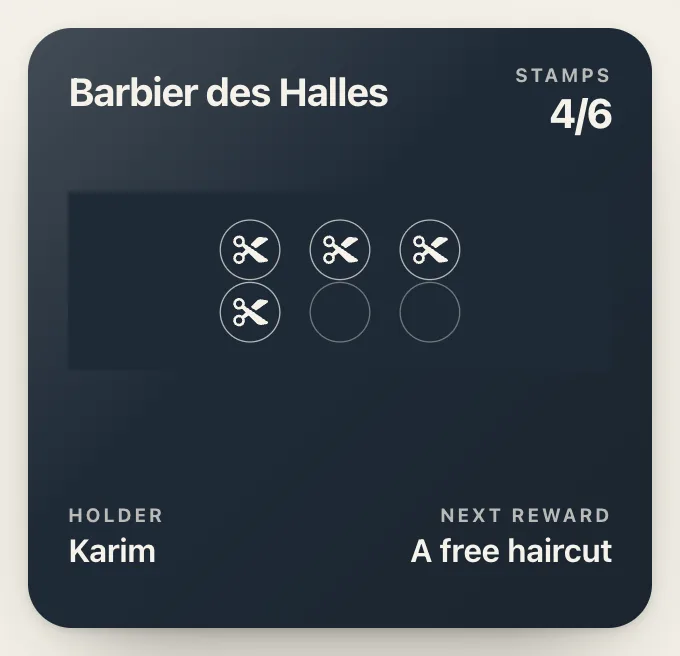
Barbershop: six visits, a free haircut
Navy blue, the "circles" layout and scissors as the stamp. Only six visits: at a barbershop, the ticket is high and visits are regular, so the goal can be short. The reward is the service itself, a free haircut, which costs time rather than stock. See also loyalty cards for hair salons and barbershops.
Tea room: points in a ring
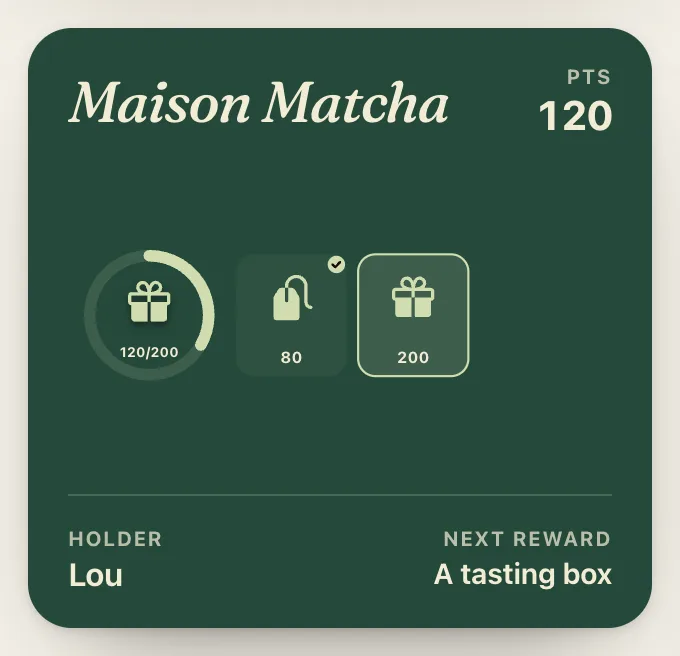
The Botanical collection on deep green, in points mode with the "ring" shape. A free tea at 80 points, a tasting box at 200. Points make sense when one customer buys a $4 tea and another a $35 gift box: each moves forward in proportion to what they spend, and the reward tiles show what’s left to earn.
Fast casual: a path dotted with photos
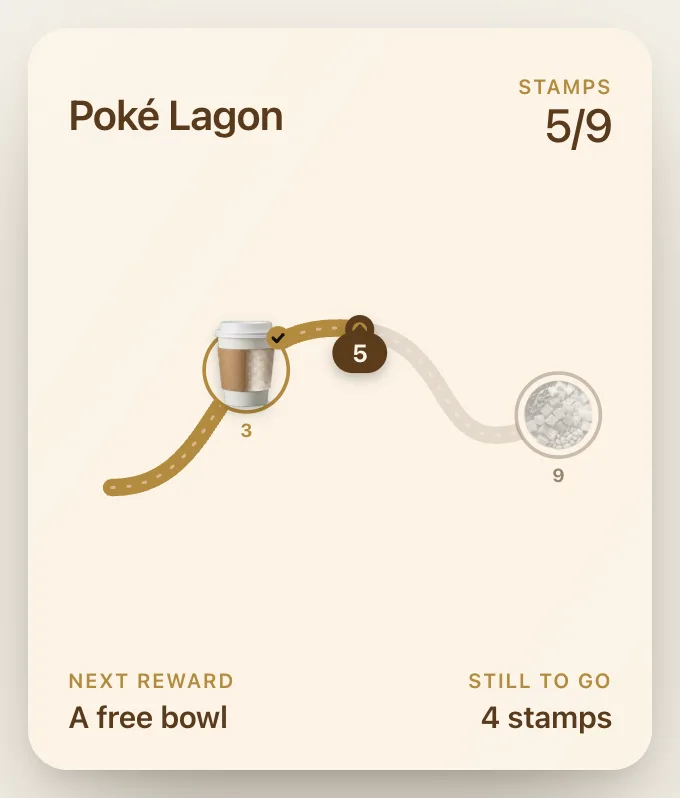
The Pass collection on cream, in tiers mode with the "path" shape. Rewards are shown as cut-out photos: a coffee at visit three, a bowl at visit nine. The path tells a little story, and the gray bowl makes people want to see it turn to color. For restaurants, see our restaurant loyalty program guide.
The stamp, the logo, the strip
The stamp. A drawn icon (cup, croissant, scissors, flower, sparkle and some sixty others), any emoji, or your own square image. The icon takes on your card’s ink color.
The logo. It sits at the top of the card and in the customer’s wallet list: they see your name, not ours.
The strip photo. Your storefront or best-selling product runs as a strip under your name. Never behind the text: a photo under words makes them unreadable half the time.
The back of the card. Address, phone, opening hours, website. Fix an opening time and it changes in every wallet.
And everything can be changed later: a new logo or color flows into cards already installed, without anyone signing up again.
Seven rules for a card people keep
Make the next reward big. With several tiers, show the one coming up, not the last. That’s the one customers chase.
Keep the goal reachable. Six to ten visits for a busy shop; beyond that, add a halfway reward.
Make the reward concrete. "A free croissant" sticks; "5% off" doesn’t. Our list of loyalty rewards that work has more.
Keep the name short. It has to fit on one line in the wallet.
Use your color, not a trendy one. The color of your storefront or packaging, so customers spot your card at a glance.
Pick a stamp that says what you do. A cup, scissors, a brush: customers know which card it is without reading.
Check it on a phone. The preview shows both the Apple and the Google version: each wallet arranges fields its own way.
And for gifts?
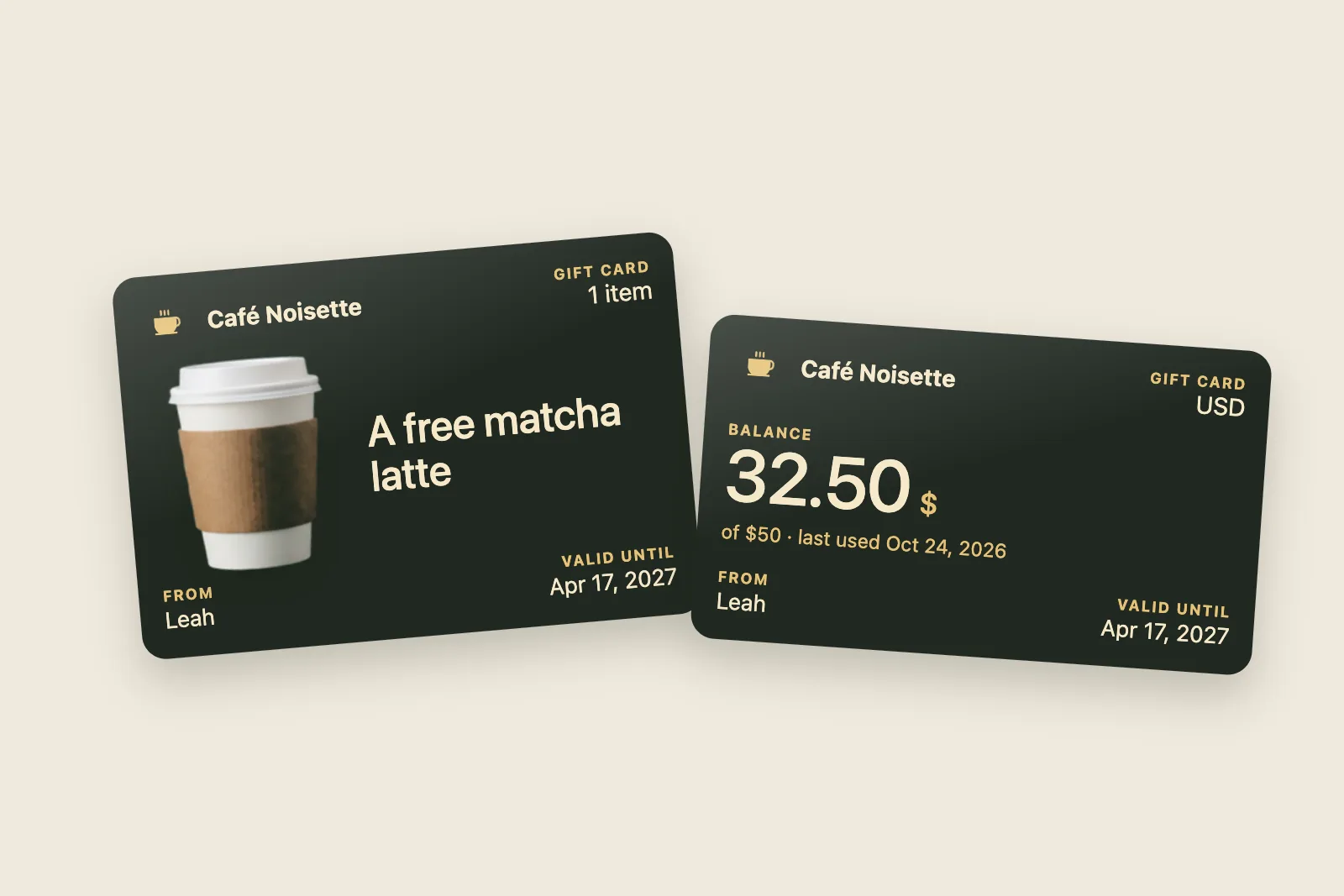
The same care goes into gift cards: a free item with its photo, or a stored amount whose balance updates in the wallet. We cover them in digital gift cards for small businesses.
What it costs
Every collection, shape and color is included from the Essential plan, at $29 a month before tax (£19 in the UK, €20 in Europe), with Apple Wallet, Google Wallet and unlimited customers. The Growth plan, at $49 (£35, €40), adds automatic messages, birthdays, Google review requests and gift cards. 30-day free trial, no commitment: see pricing.
FAQ
Do I need a designer to make a good-looking loyalty card?
No. Collections and palettes are ready, stamps are already drawn, and the preview shows the finished card before you save. The logo and photo are optional.
Can I change the design after launch?
Yes, any time. Color, logo, shape or counting mode: cards already installed update, and your customers' progress stays where it was.
Does the card look the same on iPhone and Android?
It keeps your colors, brand and stamps. Apple Wallet and Google Wallet arrange the fields their own way, and the preview shows you both.
Can I use photos of my products?
Yes, for each reward: the background is removed automatically, and the photo shows in color once the reward is earned, in gray before. You can also use your own image as the stamp.
The StampyWallet teamDigital loyalty cards for independent shops
Digital gift cards for small businesses: sell them at the counter, redeem them from the Wallet
How a café, bakery, salon or barbershop can sell digital gift cards without new hardware. A free item or a stored amount, balance deducted visit by visit, Apple Wallet, Google Wallet or print, with a full ledger.
Coffee shop loyalty program: 10 ideas that work, with the math
How many stamps, which reward, and what a free coffee really costs you. A practical guide for independent coffee shops, with worked numbers and real research.
Bakery loyalty program: rewards, stamp counts and the real cost
Which reward to give, how many stamps to ask for and what it really costs: a bakery loyalty card that survives the morning rush, on paper or in the phone.
Analytics and advertising
With your consent, Google Analytics and Google Ads measure which pages and ads lead to a signup, and Google may then show you StampyWallet ads on other sites (retargeting). Without it, only our own audience measurement runs: anonymous, it never leaves StampyWallet and can be switched off from our privacy policy. The site works the same if you decline.With your consent, Google Analytics and OpenAI’s pixel (ChatGPT ads) measure which pages and ads lead to a signup. Without it, only our own audience measurement runs: anonymous, it never leaves StampyWallet and can be switched off from our privacy policy. The site works the same if you decline.With your consent, Google Analytics and Meta (Facebook and Instagram ads) measure which pages and ads lead to a signup. Without it, only our own audience measurement runs: anonymous, it never leaves StampyWallet and can be switched off from our privacy policy. The site works the same if you decline.Our privacy policy
 Guide
Guide