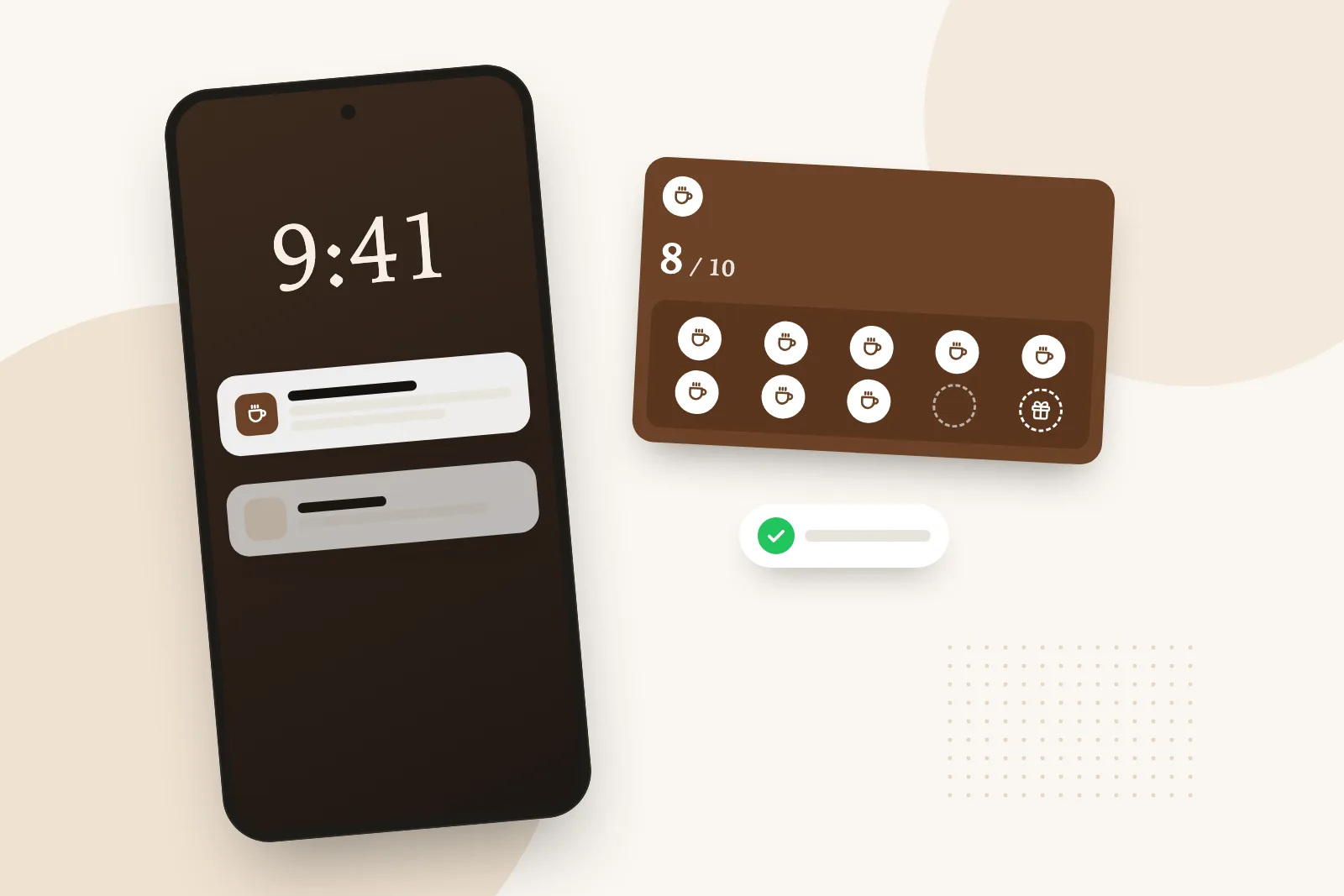
 Coffee shops
Coffee shop loyalty program: 10 ideas that work, with the math
How many stamps, which reward, and what a free coffee really costs you. A practical guide for independent coffee shops, with worked numbers and real research.
Describe your shop to Claude and it designs the card, costs the reward and gets everything ready to launch. The step-by-step, with the exact prompts and real numbers from a simulation.
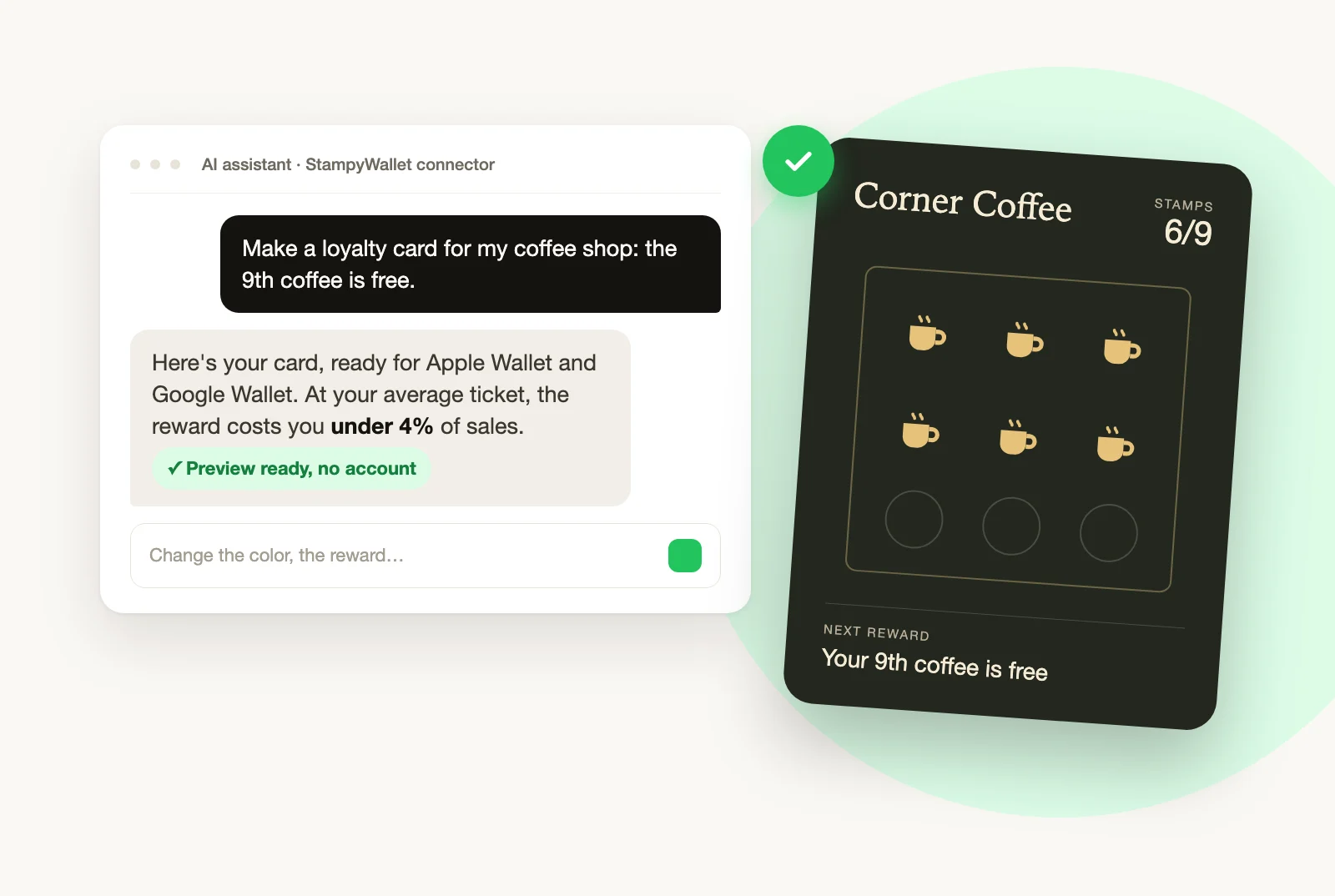
The hard part of a loyalty card isn’t the technology: it’s the choices. How many visits? What reward? Am I about to give away my margin? Those questions are easier to settle in a conversation than in a form, and that’s exactly what the StampyWallet connector lets you do inside an AI assistant.
You need an assistant that accepts custom connectors, Claude for example. Add StampyWallet with the address `https://app.stampywallet.com/mcp` (details in our connector overview). For this part you don’t need to sign in: the design tools are open to everyone.
Start simply, as if talking to someone who’s never seen your place:
I run a café in Lyon, light wood and sage green. I’d like a loyalty card: a free coffee after 8 visits.
The assistant returns a designed card: colours, icon, stamp grid, reward. It’s a preview, nothing is saved.
This is where a conversation beats an editor. You react to what you see:
Each answer redraws the card and keeps everything else. You can go back and forth ten times without breaking anything.
Before committing, ask what it costs. You need two numbers you already know: your average spend, and what the reward costs you (the cost price, not the menu price).
My average spend is $4, a coffee costs me $0.60. Compare 6, 8 and 10 visits.
Here’s what the simulation returns, with its default assumptions: one stamp given on sign-up, a 65% margin, 60 loyal customers visiting twice a month.
| Visits | Real discount | Rewards per month | Cost per month | Extra visits to break even |
|---|---|---|---|---|
| 6 | 3.0% | 24 | $14.40 | 6 |
| 8 | 2.1% | 17.1 | $10.29 | 4 |
| 10 | 1.7% | 13.3 | $8.00 | 4 |
At 8 visits, you give back 2.1% of what your regulars spend. Four extra visits a month, out of 120, and the card pays for itself. If your numbers differ, say so: "I have more like 150 regulars", "my margin is 70%", and the maths follows.
When you’re happy with it:
I like it. Create the shop.
The assistant first shows a summary and waits for your go-ahead. Once confirmed, it gives you a personal link to claim the shop: you create your account and the card is there, ready, with its QR code. Keep that link to yourself, it’s the key to your shop.
Once your account exists, reconnect the assistant and sign in. It goes from adviser to business partner: it reads your visits, finds customers by first name and drafts messages for the ones drifting away. Always with a preview before anything is sent.
Stamps stay at the counter: you add them by scanning the customer’s card from your phone.
No. Designing the card, comparing palettes and costing the reward all work without an account. You only need one when you claim the shop.
Claude works today through a custom connector. Any MCP-compatible assistant that accepts a connector address can use it too.
Nothing. Previews aren’t saved. You can pick the conversation up later, or start over.
No. Colours, reward and number of visits can be changed afterwards, in the app or from the assistant connected to your account.
Compare several in the simulation. A real discount between 2% and 5% of what your regulars spend is a common range: enough to motivate, not enough to eat into your margin.
Coffee shops
How many stamps, which reward, and what a free coffee really costs you. A practical guide for independent coffee shops, with worked numbers and real research.
 Bakeries
Which reward to give, how many stamps to ask for and what it really costs: a bakery loyalty card that survives the morning rush, on paper or in the phone.
 Guide
Guide
Apple Pay has no loyalty program for your shop, and one-tap loyalty needs certified NFC hardware. What really exists in 2026, and what works at a small counter.