 Tips
Tips
How to keep customers coming back to your shop or cafe
Practical, low-effort strategies to build genuine customer loyalty — without a big marketing budget or complicated software.
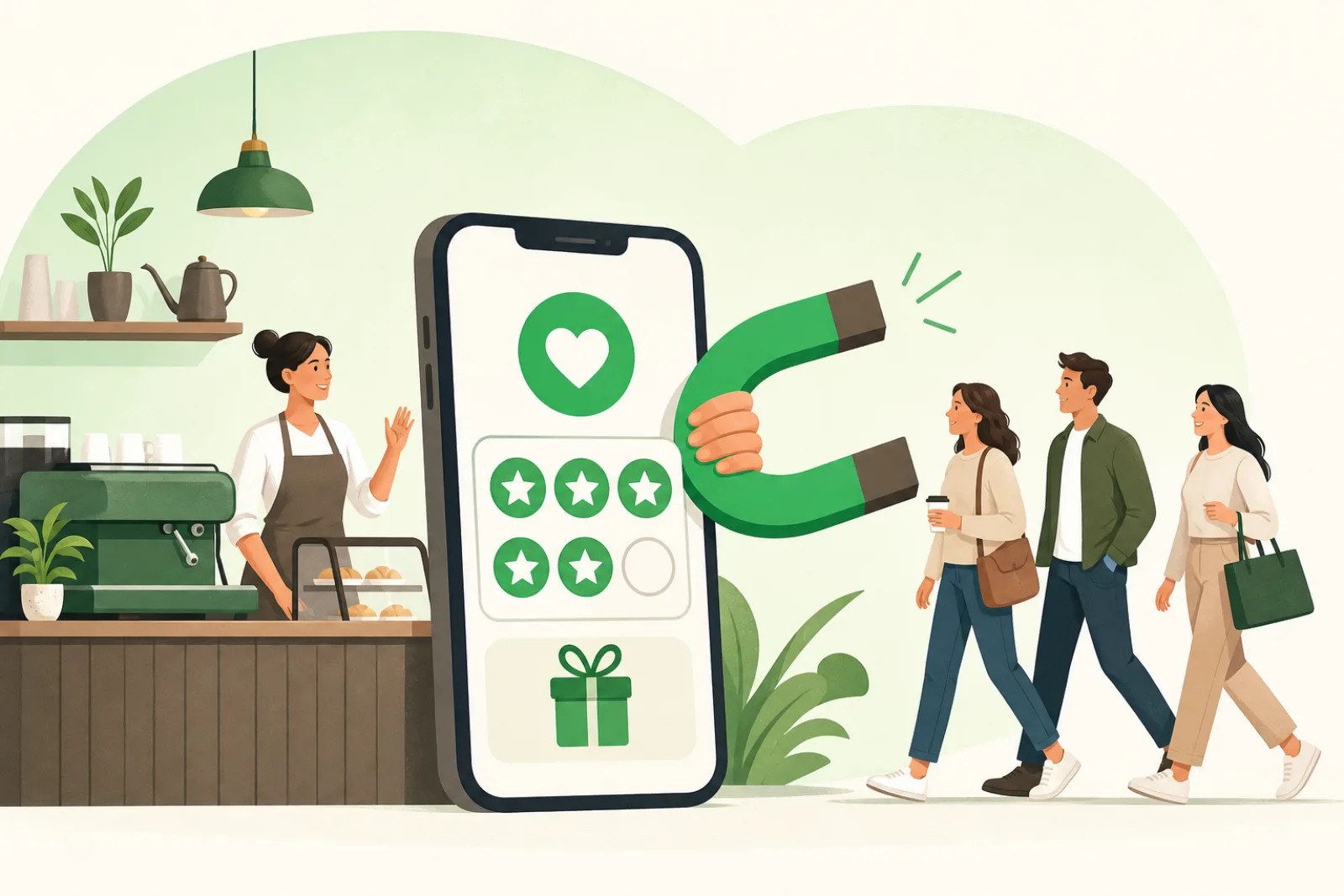
The mechanic hasn't aged: nine coffees, the tenth free. The cardstock has. The same counter, living in the phone, keeps what works and removes what gets in the way.
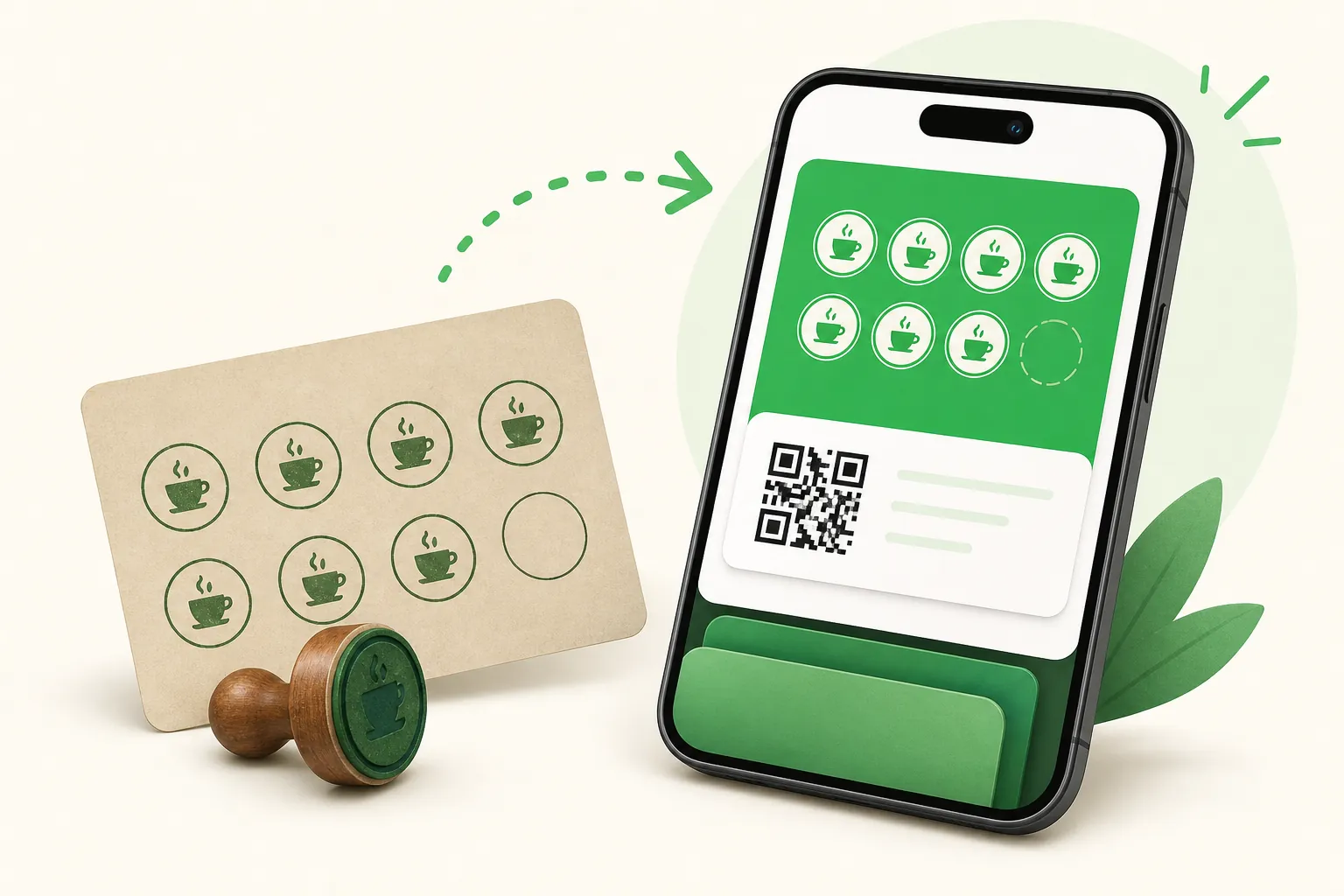
There’s something genuinely clever about the paper stamp card. Buy nine coffees, get the tenth free. Simple, tangible, no explanation needed. Customers got it instantly, and for decades it worked well enough.
But "well enough" has a ceiling. Cards get lost in coat pockets. Regulars leave them at home. Someone picks up a card that isn’t theirs and starts collecting stamps they didn’t earn. And when a customer hasn’t visited in three weeks, you have no way to reach them — between visits, cardstock is mute.
The good news is that the format isn’t at fault. Collect, hit a threshold, get rewarded: as effective as ever. What needed to change was the medium.
Before getting to the digital version, it’s worth understanding why the stamp card has buried so many more sophisticated programmes.
It shows progress. Each stamp is a visible step toward a goal. A card with seven of ten filled pulls toward the eighth visit; a points balance buried in an app pulls toward nothing.
It commits to nothing. No account, no password, no points-to-currency conversion to work out. You visit, you get a stamp, you come back. That simplicity is a feature, not a limitation.
It needs no training. You stamp a card. That’s the whole interaction, and it’s why the stamp card never got quietly abandoned halfway through, the way a badly installed loyalty system does.
The digital version keeps all of that. It only removes what jams.
A paper card lives in a wallet, a bag or a drawer. It goes through the wash with the jeans. It stays at home on exactly the day the customer wanted their reward. Every lost card is a broken loyalty loop — and a customer starting over, annoyed.
The digital card lives in Apple Wallet or Google Wallet, on the phone your customers are already holding. It doesn’t fall out, it doesn’t fade, and it doesn’t get left on the hall table.
Leave a stack of blank cards on the counter and anyone helps themselves. A customer who already has one takes a second. The counter is kept by a rubber stamp anyone can order online.
With a digital card, enrolment goes through a scan, and you place every stamp yourself from your phone. There’s no stack left to raid.
This is cardstock’s most expensive limitation, and it has no cardstock solution. If a regular hasn’t been in for three weeks, there’s nothing you can do: you don’t have their name, their address or their number.
The digital card changes that completely. It writes on the lock screen: to all your customers, to the ones a single stamp away, or to the ones who haven’t been in for thirty days. It’s a direct line to people who already like your business.
With paper you’re flying blind. How many loyal customers do you actually have? How often do they come? Which regulars are quietly drifting away?
The dashboard answers all three — visits day by day, your best days of the week, and lapsed customers counted in opening days rather than calendar days.
The mechanic doesn’t change. The delivery does.
A customer walks up to the counter and sees a small QR code. They point their phone camera at it. The card appears and drops into their wallet — Apple Wallet or Google Wallet, depending on the phone. No app to download, no account to create, no form. Ten seconds.
When they come back, you open a web page on your own phone and place a stamp. No tablet, no connected till, no hardware. The stamp shows up on their card straight away.
At the tenth, the reward unlocks by itself. They see it, you see it. No more "have I already given you that one?".
| At the counter | Paper stamp card | The same card in the wallet |
|---|---|---|
| The customer forgot their card | Stamp lost, or given from memory | The card is in their phone |
| Card lost, washed, torn | Nine visits of history gone | Nothing is lost, it lives on the server |
| Who keeps the count | A stamp anyone can order | You, from your phone |
| Reaching a customer between visits | Impossible, you have nothing | A line on their lock screen |
| Knowing who is drifting away | You find out too late | The list is there, with the last visit date |
| What it costs | A reprint every six months | Included in the subscription |
This matters more than most merchants expect. Your customers don’t want to learn a new system. They want their free coffee.
The digital format keeps the mechanic intact: collect, hit the threshold, get rewarded. The card sits in the wallet next to a boarding pass or a train ticket — visible without opening anything. When they’re one stamp away, a reminder arrives on its own.
No username, no password, no points conversion, no app to update. The experience is simpler than paper exactly where it counts: the card is always there, always current, and the reward unlocks itself.
Picture an independent café on a Saturday morning. You’re handing out paper cards, stamping the ones customers remembered to bring, and watching others leave with nothing because theirs is at home. Three weeks later, you have no idea who didn’t come back.
With a digital card, the Saturday morning is identical: the customer scans, the card lands in their wallet, you stamp from your phone. But three weeks later you know exactly who’s missing — and you can tell them so.
For a salon or barbershop the logic is the same and the stakes are higher: appointments are further apart, so the silence lasts longer. A message to someone who hasn’t booked in six weeks fills a slot that would have stayed empty.
For a bakery it’s throughput that matters. A QR code on the counter enrols a customer without slowing the queue: no card to find, no "do you have yours on you?".
The legitimate fear with any new tool is that it complicates service or means training the team. A stamp card in the wallet avoids both.
No hardware. No integration with your till. No app to learn. You stamp from your phone’s browser, the way you’d read a message; your customers scan a QR code, the way they’d read a menu.
Setup is a one-off task. After that the system runs itself: rewards unlock, reminders go out, and you look at your numbers when you feel like it.
No. They scan a QR code with the phone camera, and the card is added to Apple Wallet or Google Wallet, already on the device. No app, no account, no password.
It’s tied to their wallet account, not the device. They get the card and its stamps back by restoring their wallet on a new phone — which a lost paper card never allows.
Yes, on their lock screen. To everyone, to those one stamp away, to those who haven’t been in for thirty days, or on their birthday. Never during your quiet hours: you set the windows.
No. You stamp from a web page, on any phone. Your staff can each have their own access at no extra cost. And if you’d rather your till did the counting, points mode works with SumUp or Zettle.
A stamp card counts visits: ten visits, one reward. A points programme turns spending into a currency to spend later. Stamps are easier to read, so they get followed more closely — but if you reward the amount spent, points mode exists too.
Thirty days free, no commitment. After that it’s €19 excl. VAT per month at the founder rate, held for the first hundred shops, or €190 a year. One subscription per location, cancellable in one click.
Your customers' cards keep working, and you can export your data whenever you want. A customer’s card never depends on your subscription.
Tips
Practical, low-effort strategies to build genuine customer loyalty — without a big marketing budget or complicated software.
 Beauty
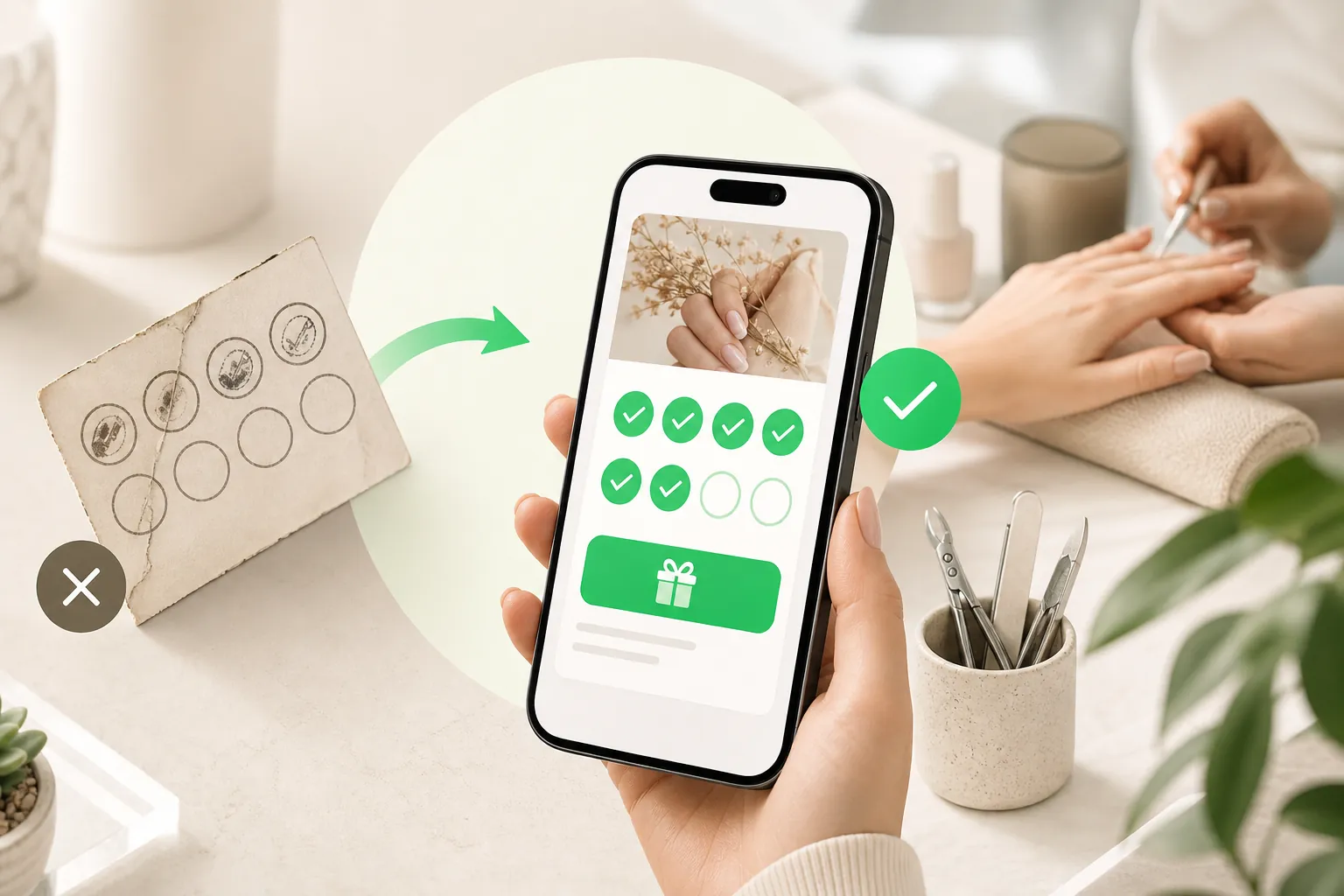
Your clients already come back every two or three weeks. A digital loyalty card turns that habit into something you can see and act on — no forgotten card, no hardware, no extra work at the desk.
 Tutorial
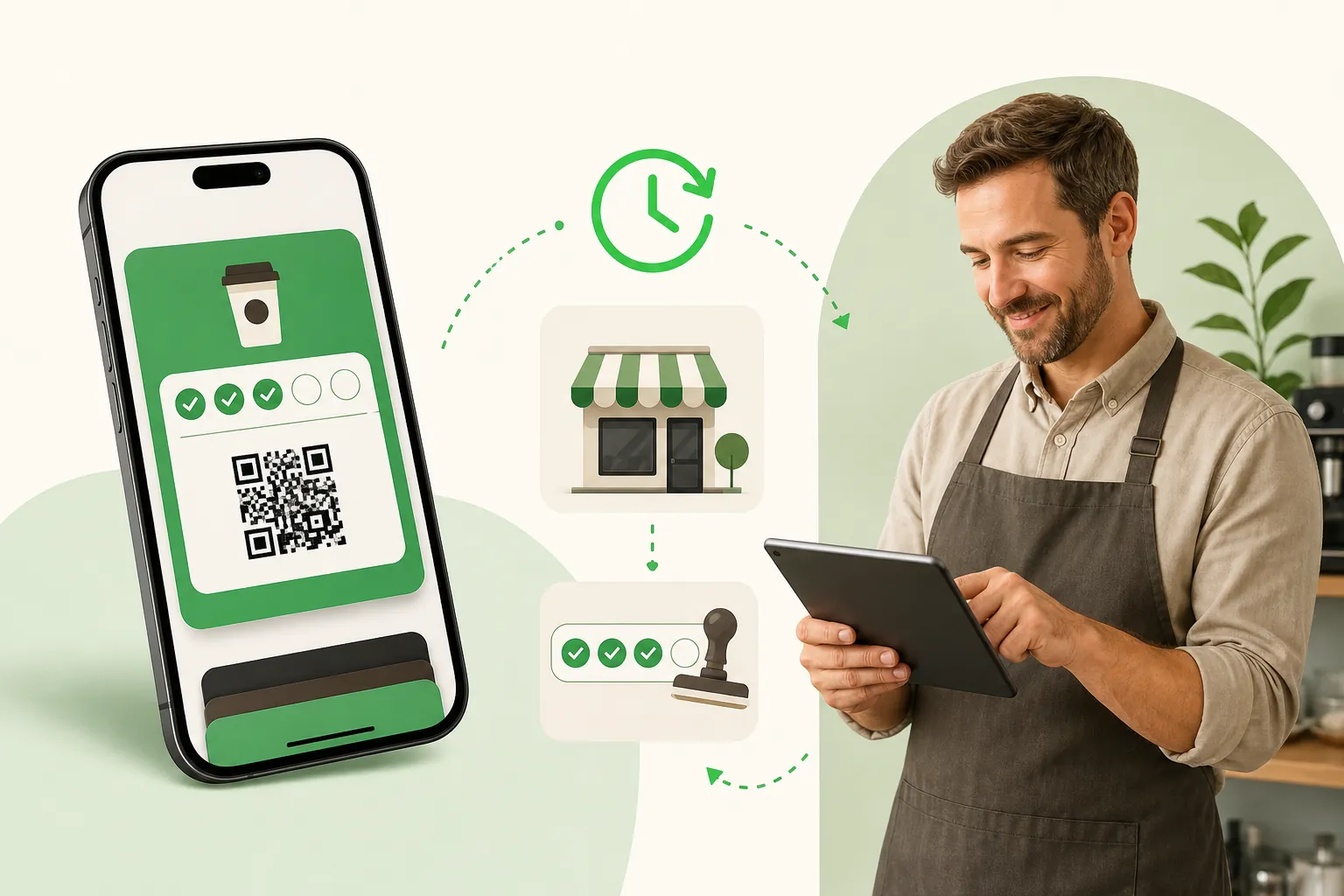
Put a real Apple Wallet loyalty card in your customers' phones — no developer, no hardware, and nothing for them to install. Here are the five steps, in order.